

Key Takeaways
A careful match, written warranty terms, and realistic installation costs matter when buying a used Toyota engine or transmission.
- Confirm the vehicle model, year, engine or transmission code, and drivetrain before requesting a quote.
- Ask what testing was completed and which components are included with the replacement part.
- Read the warranty conditions, exclusions, claim process, and installation requirements before paying.
- Compare the total fitted cost, not only the advertised price of the used part.
- Use a qualified mechanic to inspect and install the replacement component.
Why choose Toyota wreckers in Gosford for replacement parts
A local wrecker can be a practical starting point when a Toyota needs a major replacement component. Used engines and transmissions may cost less than new dealer-supplied alternatives, while recycled parts can keep a repair moving when availability is limited. The key is to treat the purchase as a compatibility and condition decision, not simply a bargain hunt.
A good enquiry gives the seller enough information to identify a suitable part and explain its history. That usually includes the vehicle identification number, model, build year, engine size, transmission type, and the symptoms or failure that led to the replacement.
How vehicle wreckers source and inspect Toyota components
Vehicle wreckers generally recover usable components from dismantled vehicles, but the condition of one part can differ greatly from another. Ask whether the engine or transmission was removed from a running vehicle, whether its mileage is recorded, and what visual or functional checks were performed. Condition evidence matters more than a vague description such as “good used.”
Inspection questions should be specific without assuming that every wrecker follows the same process. Clarify whether the component was checked for leaks, damage, corrosion, unusual noise, or other obvious concerns, and ask for any available photographs or inspection notes.
The benefits of choosing recycled OEM parts
A recycled original-equipment component was designed for the same vehicle family, which can make it a sensible option when the correct specification is confirmed. It may also preserve the vehicle’s existing configuration rather than requiring unrelated modifications. That said, “OEM” does not automatically mean the part is in perfect condition; age, storage, mileage, and prior maintenance still need consideration.
The environmental benefit is another reasonable part of the decision. Reusing a serviceable assembly reduces the need to manufacture a replacement from new materials, while giving an otherwise usable vehicle component another working life.
When a used engine or transmission makes financial sense
A used assembly can make financial sense when the vehicle is otherwise sound and the replacement cost is comfortably below the car’s current value. It is less attractive when the vehicle also needs major suspension, electrical, body, or cooling-system work. Obtain a written estimate that separates the part, labor, fluids, seals, freight, and any related repairs.
The comparison should include risk as well as price. A cheaper engine with uncertain history may create a second repair bill, whereas a documented part with a clear warranty can be easier to budget for, even if its initial price is higher.
How local Gosford service can simplify parts sourcing
Buying near Gosford can make communication, collection, and follow-up simpler, particularly when a mechanic wants to inspect the part before installation. Local contact also makes it easier to discuss whether the component is complete, whether accessories are attached, and whether delivery to a workshop is available. Confirm these details rather than assuming the advertised location covers every service.
For a buyer comparing Toyota wreckers Gosford – used engines & transmissions with warranty, the useful question is not only who has stock. It is who can provide a clear match, realistic condition information, and written terms that your mechanic can work with.
Finding the right used Toyota engine
Engine replacement begins with identification. Two vehicles that look similar may use different engine codes, mounts, sensors, emissions equipment, or computer systems. A reliable quote therefore depends on precise vehicle information rather than a model name alone.
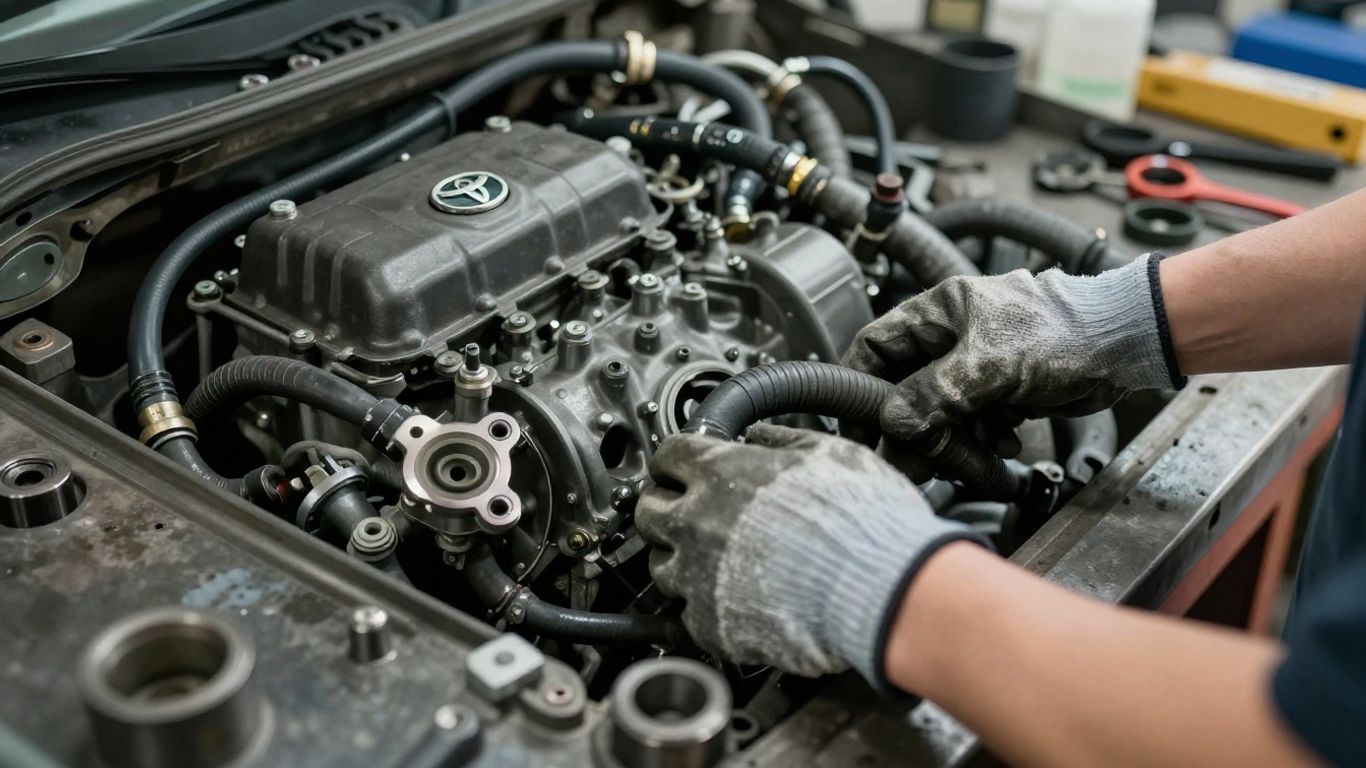
Ask for the engine’s recorded mileage and source details where available, then compare the supplied assembly with what your mechanic expects to remove. The image below reflects the kind of physical component and workshop context buyers may encounter during this process.
Matching the engine to your Toyota model and year
Start with the exact model, build year, body style, engine size, fuel type, and drivetrain. Facelift changes and regional specifications can affect sensors, wiring, accessories, and control units. The VIN is usually the strongest starting point, but a clear photograph of the compliance plate or engine bay can help resolve questions.
Do not assume that an engine listed for the same model will be a direct replacement. Ask whether the quoted item is supplied as a complete engine or whether existing accessories, manifolds, wiring, and electronics must be transferred.
Checking engine codes, specifications, and mileage
The engine code should be compared with the vehicle’s original code and the mechanic’s compatibility advice. Mileage is useful, but it is only one part of the condition assessment: service history, storage, oil contamination, compression information, and signs of overheating may be equally relevant. Request the information in writing so it can be checked against the quote and warranty.
The following comparison can help organize the questions before committing to a part.
| Detail to verify | Why it matters | What to request |
|---|---|---|
| Engine code | Confirms the basic specification | Code from the donor or assembly |
| Recorded mileage | Helps compare likely wear | Source record or written estimate |
| Included accessories | Defines what you actually receive | List of attached and excluded parts |
| Testing information | Gives context about condition | Inspection notes or test results |
A table cannot replace a mechanical inspection, but it reduces misunderstandings between the buyer, wrecker, and installer. If one answer is unavailable, record that as an uncertainty rather than treating it as confirmation.
Comparing complete engines with long blocks and partial assemblies
A complete engine may include more of the accessories and sensors needed for the swap, while a long block generally leaves some existing components to be transferred. A partial assembly may have a lower purchase price but require more labor and more opportunities for compatibility problems. Ask for a component-by-component description before comparing prices.
Your mechanic can also identify which parts from the failed engine are reusable. In some cases, keeping selected accessories is practical; in others, contamination or damage makes replacement safer. The cheapest assembly is not necessarily the cheapest installation.
Questions to ask about testing and condition
Ask how the engine was removed, how it was stored, what testing was completed, and whether any faults were found. Request information about leaks, unusual noise, visible damage, and whether the engine was drained or preserved for storage. If test results are not available, ask what the warranty does and does not protect.
A careful seller should be able to explain the limits of the information available. Your mechanic can then decide whether the risk is acceptable or whether a different assembly, inspection, or repair path is more suitable.
Choosing a used Toyota transmission
Transmission compatibility is more exacting than simply choosing automatic or manual. Gear ratios, control systems, transfer cases, driveshafts, mounts, and output arrangements can all affect whether a replacement will work. Begin with the original vehicle details and the transmission code where possible.
A replacement should also be assessed in the context of the failure. A slipping clutch, damaged shifter, electrical fault, or differential problem may not be solved by replacing the transmission alone. Proper diagnosis helps prevent buying the wrong assembly.
Identifying automatic and manual transmission requirements
Confirm whether the vehicle uses an automatic or manual transmission, then record the number of speeds, drive layout, engine pairing, and any relevant transfer-case arrangement. Manual vehicles may need separate consideration of the clutch, flywheel, release bearing, and hydraulics. Automatic vehicles may require attention to the torque converter, cooler lines, sensors, and control system.
Ask exactly what is included. A quoted gearbox may not include every external component needed for installation, and the existing unit may have failed because of a related part rather than the main casing.
Verifying transmission codes, specifications, and drivetrain compatibility
The transmission code is a central matching detail, but it should be checked alongside the VIN and drivetrain configuration. Differences between two otherwise similar vehicles can affect mounting points, electronics, ratios, or connection points. Give the seller and mechanic the same information so the quote is based on one consistent vehicle description.
If the code is difficult to read, provide photographs of the identification markings and the original unit. Never rely on a visual resemblance alone when a code or VIN check is available.
Understanding mileage, fluid condition, and inspection records
Mileage can provide a useful comparison between available units, but it does not prove how a transmission was used or maintained. Ask whether the fluid showed excessive debris, burning, water contamination, or an unusual smell, and whether the casing has signs of impact or leaks. Inspection records may be limited, so ask what was actually observed rather than requesting a blanket assurance.
Your mechanic should review the information with the vehicle’s symptoms. A transmission that looks acceptable externally may still need additional testing or related repairs before it is installed.
Deciding between a used, rebuilt, and remanufactured transmission
A used transmission is generally a recovered assembly in its existing condition, subject to the seller’s inspection and warranty terms. Rebuilt and remanufactured descriptions can mean different things between suppliers, so ask what work was performed, which parts were replaced, and what testing followed. Price comparisons are meaningful only when the scope of work is clear.
Choose the option that fits the vehicle’s value, repair budget, and expected service period. A qualified mechanic can help weigh a lower-cost used unit against the greater documented work of another option without assuming that one label guarantees a particular result.
Understanding warranties on used engines and transmissions
A warranty can reduce uncertainty, but it is not the same as a guarantee that every related repair will be covered. The written document should identify the component, coverage period, exclusions, claim process, and installation requirements. Read it before purchase, not after a problem appears.
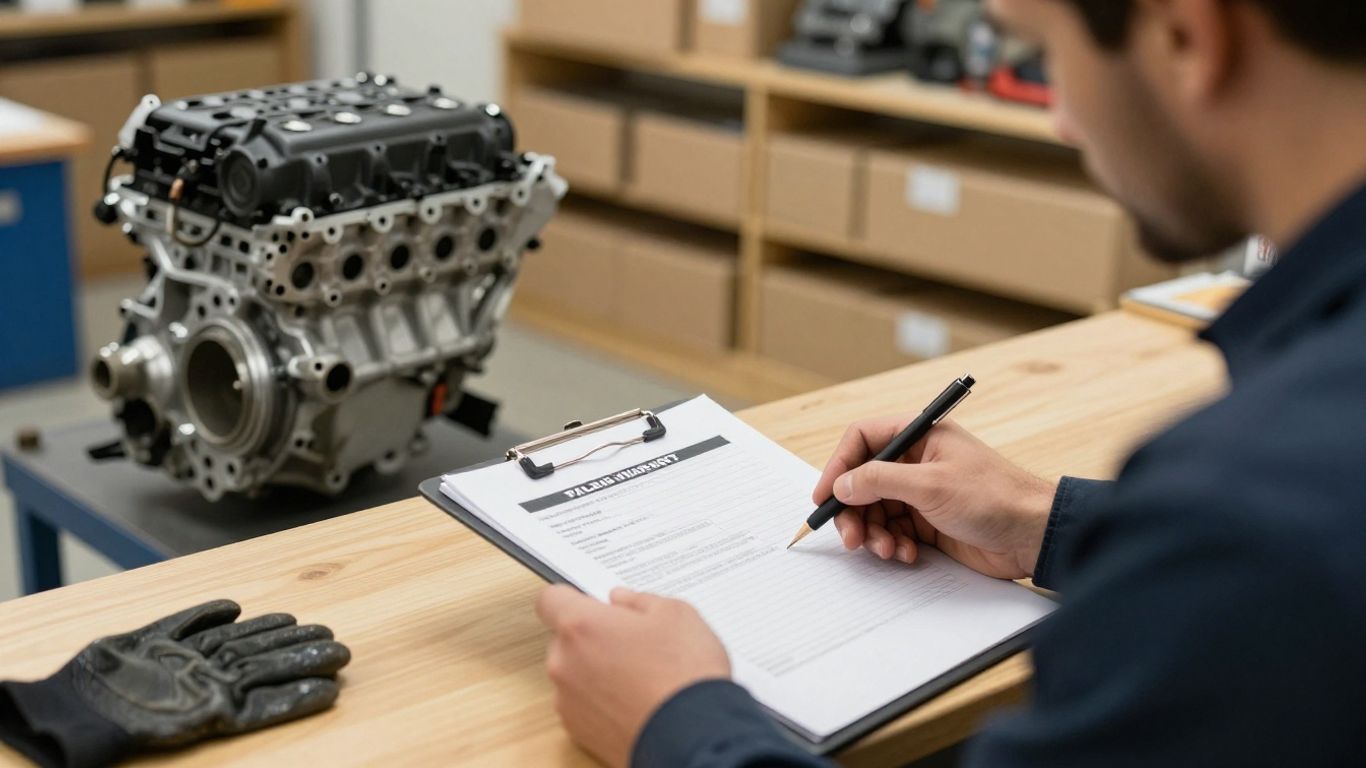
The image below depicts a typical workshop handover setting, where paperwork and a replacement assembly are reviewed before installation. Keep the conversation practical: ask what evidence is needed if a claim is made.
What a typical parts warranty may cover
A parts warranty may cover specified internal failures in the engine or transmission for a stated period, subject to its conditions. It may not cover labor, towing, diagnostics, fluids, seals, sensors, accessories, or damage caused by another faulty vehicle system. Only the written terms can establish the actual scope.
Ask whether the warranty applies to the complete assembly or only named internal components. Also clarify whether replacement, repair, refund, or inspection is the available remedy if a covered fault is accepted.
Warranty periods, exclusions, and claim requirements
Warranty periods may be measured in time, distance, or both. Common exclusions can relate to overheating, lack of lubrication, incorrect installation, racing, modification, contamination, or continued use after a fault becomes apparent, but the seller’s document controls. Do not treat general industry language as a substitute for the actual terms.
Before purchase, ask how quickly a problem must be reported and which records must be supplied. Knowing the procedure in advance can prevent delays when a mechanic identifies a concern.
Why installation conditions can affect warranty coverage
Major assemblies interact with cooling, lubrication, electrical, fuel, and transmission systems. If a related fault remains unresolved, it may damage the replacement part and affect a warranty assessment. The installer may therefore need to replace specified consumables, flush a system, or verify operating pressures before returning the vehicle.
A warranty is most useful when the buyer understands the conditions before the part is fitted.
That principle is simple but practical. Ask your mechanic to review the requirements, and obtain approval in writing if the proposed installation differs from the supplier’s stated process.
How to confirm the warranty before purchasing
Request the warranty document or full terms with the quote. Confirm the start date, distance limit, covered components, exclusions, labor position, claim contact, and required installation records. Ask whether the warranty transfers if the vehicle is sold and whether a core return or inspection is part of the process.
Save the quote, invoice, warranty, photographs, and mechanic’s report together. Clear records make it easier to show what was purchased, how it was installed, and when any issue appeared.
Buying Toyota used parts from a Gosford wrecker
A strong purchase enquiry is concise but detailed. It gives the wrecker enough information to search accurately and gives you enough information to compare one option with another. Written communication is especially helpful when several components or delivery arrangements are involved.
Do not be discouraged if the seller asks follow-up questions. Those questions may reveal a useful difference between a general model match and a properly checked replacement.
Information to provide when requesting a quote
Provide the VIN, model, build year, engine size, fuel type, transmission type, drivetrain, and the part required. Include the original engine or transmission code if known, along with photographs of identification markings. Mention whether you need a complete assembly, a long block, a transmission with torque converter, or another specific configuration.
Also state your location, desired delivery date, and whether a mechanic has identified any related parts that must be supplied. A complete brief usually produces a more useful quote than a short request for “a Toyota gearbox.”
Comparing availability, pricing, and part condition
Compare more than the headline price. Record the part’s mileage, donor details, test information, inclusions, warranty, and expected dispatch time. If two prices differ, ask what explains the difference rather than assuming the higher one is automatically better.
A simple written comparison helps separate known facts from unanswered questions. It also gives your mechanic a clearer basis for deciding whether the proposed part suits the repair.
Confirming delivery or pickup options around Gosford
Ask whether collection is available, where it occurs, how the assembly will be packaged, and whether delivery to a Gosford-area workshop can be arranged. Engines and transmissions are heavy, so freight, unloading, and inspection timing should be considered before the part leaves the yard.
Confirm the delivery contact, address, and any damage-reporting procedure. Photograph the packaging and component on arrival if the supplier recommends evidence for freight or warranty matters.
Checking return policies and included components
Before paying, confirm whether the part can be returned if the code or specification does not match, and who pays return freight. Ask what happens if the mechanic finds damage on inspection or discovers that an excluded accessory is needed. Return rights and warranty rights are separate questions, so obtain both in writing.
The invoice should describe the component and any included items clearly. That small step can prevent disputes over sensors, brackets, converters, wiring, or other parts that were assumed but never included.
Preparing for Toyota engine or transmission installation
Installation is part of the replacement decision, not an afterthought. A used assembly may need preparation before it is fitted, and the surrounding vehicle systems may have contributed to the original failure. Planning this work protects the new component and gives the warranty process a clearer foundation.
Use a qualified mechanic familiar with the vehicle and ask for a written installation estimate. It should identify the work included, likely consumables, testing after installation, and any repair that must be completed before the vehicle returns to service.
Having a qualified mechanic inspect the replacement part
Have the mechanic inspect the component before installation where possible. They can check identification markings, visible damage, mounting points, seals, connectors, and signs of leakage or contamination. If something does not match the quote, pause and contact the seller before modifying or fitting the part.
An inspection is particularly useful when the assembly is supplied without every accessory. It allows the installer to decide what can be transferred safely and what should be replaced while access is easy.
Replacing seals, fluids, filters, and related components
New seals, fluids, filters, gaskets, and other service items may be sensible during installation, depending on the assembly and the mechanic’s inspection. These items are relatively easy to address while the engine or transmission is accessible. Follow the vehicle and supplier requirements rather than using a generic parts list.
Ask which consumables are included in the quoted installation and which are additional. Separating those costs early makes the final repair bill easier to understand.
Flushing and preparing the vehicle’s cooling or transmission systems
The original failure may have left contamination in the cooling or transmission systems. A mechanic can determine whether flushing, cooler inspection, line cleaning, or other preparation is required before the replacement is connected. Skipping this assessment may expose the replacement to the same underlying problem.
The correct procedure depends on the vehicle, failure mode, and replacement component. Ask the installer to document what was checked and what work was completed, especially when the warranty lists system preparation as a condition.
Keeping invoices and installation records for warranty support
Keep the parts invoice, warranty document, mechanic’s invoice, diagnostic notes, fluid receipts, and any photographs together. Record the installation date and vehicle mileage, then note when the vehicle was first driven after the repair. Good records protect your options if a problem later needs assessment.
Do not discard the failed component until the seller confirms that it is no longer needed. Some suppliers require inspection, return, or core handling before a warranty matter can be finalized.
How to get better value from Toyota wreckers Gosford
Value comes from choosing a part that fits, can be installed sensibly, and has terms you understand. A low advertised figure can change once freight, labor, fluids, seals, programming, and related repairs are added. Compare complete repair estimates rather than isolated listings.
It is also worth being honest about the vehicle’s remaining life. A used engine or transmission can be a sensible repair for a well-maintained car, but not every failing vehicle benefits from a major replacement.
Comparing total replacement cost instead of the part price alone
Request a total estimate that separates the used part, freight, removal, installation, fluids, filters, seals, diagnostics, and post-installation testing. Include possible accessory transfers and any required programming or adjustment identified by the mechanic. This gives you a realistic figure for deciding whether the repair is worthwhile.
When comparing quotes, use the same assumptions. A price for a bare assembly is not directly comparable with one that includes accessories, consumables, inspection, and a longer written warranty.
Considering labor, freight, core returns, and additional parts
Labor can vary substantially depending on access, vehicle configuration, and how much must be transferred from the original assembly. Freight and unloading also matter for heavy parts, while a core return may involve a deposit, deadline, or transport charge. Ask for these items before authorizing the purchase.
A written breakdown does not make the repair risk-free, but it exposes costs that are easy to overlook. It also gives you a useful record if the scope changes after the mechanic inspects the vehicle.
Using the vehicle identification number for accurate matching
The VIN helps connect the quote to one specific vehicle rather than a broad model range. Supply it at the start and ask the seller to confirm the match in writing. Pair it with the original code and photographs when available, especially if the vehicle has been modified or imported.
If the seller cannot confirm compatibility, ask your mechanic or a qualified parts specialist to verify it before payment. A few minutes of checking can prevent a costly return or an unusable delivery.
Knowing when a used part is not the right solution
A used assembly may not be appropriate when the vehicle has extensive additional damage, uncertain structural condition, or a repair estimate close to the car’s market value. It may also be unsuitable when the failure requires a thoroughly rebuilt component and the available used unit has too little condition information. Those are financial and mechanical judgments, not signs that every used part is poor value.
Ask for an independent assessment when the decision is difficult. If the risks, warranty limits, and total costs are clear, you can choose repair, another replacement option, or retirement of the vehicle with better confidence.
Conclusion
Buying from Toyota wreckers Gosford – used engines & transmissions with warranty can be a practical route to a major vehicle repair when compatibility, condition, warranty terms, and installation costs are checked together. Give the seller accurate vehicle details, involve a qualified mechanic, and compare the complete repair cost before committing. A careful process will not remove every uncertainty, but it can make the decision clearer and the finished repair easier to support.